Showing posts with label Archaeology. Show all posts

Tuesday, 20 January 2015

A bit of fun!!

Butser Ancient Farm is many different things, it is an Open air museum where the public can learn about the Prehistory and Roman history of Britain. It is an education provider, teaching school children through hands on activities about British history. It is a site of scientific research, exploring the many questions we have about our past.

It is also the best place to work as it allows me to have fun like this!

Look closely at my feet.....can you guess what I am wearing? (Havey, 2015).

In the autumn of 2013 I brought a set of prehistoric ice skates made from the toe bones of a cow on the promise of the seller of a harsh winter......... it did not happen, so these two skates have been sitting around idol for some time.

The afore mention ice skates that have been gathering dust and  suffering neglect (Watts, 2015).

Today however was my day to try them out! As I got into work this morning it was bitterly cold, the thermometer in the Janus building said -2! So as I walked around site to open up the site I noticed that not only were all the animals waters frozen over but there was ice in the two log boats that we have at the farm........... an idea started to form!


So I strapped on the ice skates (after some confusion as to how to do this) and I stepped foot on the ice! Not knowing what to expect, the skates felt very natural to stand on, on the ice, and I felt very secure....... though as I found out the ice was not as thick as I thought it was on one end of the puddle in the boat!


It didn't matter, I was bitten by the bug and I had another log boat filled with water to to try and skate on! This time the ice held and I comfortably managed to keep skating on the frozen Prometheus. It was great fun and although did not answer any archaeological questions it helped show people that these two bones that I have had lying around for years actually are ice skates!

A brief article about the archaeological finds can be found here


Monday, 19 January 2015


Neolithic House1 at Butser Ancient Farm based on archaeological evidence from Durrington Walls (Wiltshire, England). (Freeman, 2014).

It is often thought that the main focus of the work at Butser Ancient Farm is to focus on the construction of ancient buildings. However we are also interested in the life of the buildings we construct and their final failure and collapse. As a site of experimental archaeological research we learn just as much from watching buildings collapse as we do constructing them in the first place. In some cases we even find it necessary  to take down a building before it collapses and during this ‘accelerated collapse’ we are able to look into many aspects of the remains archaeologists may find in the ground.

This ‘accelerated collapse’ process was deemed necessary early this month with the first Neolithic house constructed at the farm. Due to many different factors, different elements of the house were starting to fail and, with high winds forecast the decision was made that the house needed to be dismantled for health and safety reasons.

You can see the split in the 'Y' fork holding up the main cross beam of the roof! (Watts, 2015).

You can see how loose some of the bindings in the building were. This raw hide lashing was of little structural use at this point in time (Scanlan, 2015).

 Rather than being a disappointment this was a fantastic opportunity for us to record the ‘accelerated collapse’ of the building and gain a better understanding of how we can create what we find in the archaeological record.

The destruction of the house took just a day. During the whole process detailed records were being taken, from the state of the bindings used to hold the building together to the spread of the daub (wall covering) on the floor. The process was carried out in a way that would replicate what might happen to the building if left to decay of its own accord. This meant small detailed destruction rather than smashing it down with a sledge hammer or two!


Videos of the 'accelerated collapse' of Neolithic1. This was my first attempt at time lapse photography of a project so apologise for the roughness of the video but I have learnt so much from just this video the next ones are bound to be better! Working on the process are myself Ryan Watts, Will Scanlan, Phoebe Harris and Work Experience Jackie. 

The findings of the process are still being analysed and will be published once they have been completed but initial observations are very exciting especially concerning the spread of the wall material on both sides of the walls.

The spread of chalk based daub on the outside of the building (Watts, 2015).

The house that was dismantled was based on evidence from Durrington Walls (Wiltshire, England) which have also been recently reconstructed at the new Stonehenge visitor centre. These reconstructions have been built with walls fully covered with chalk based daubed because of a small chalk spread excavated on the outside of one of the original buildings.

The preliminary results of the ‘accelerated collapse’ of our construction demonstrates that if the entire wall was covered in a chalk based daub then the spread of material discovered would be seen on both the inside and outside of the building and not just on the outside as the Durrington Walls archaeology shows.

The spread of the chalk based daub on the inside of the house. If the wall was fully covered with chalk daub then we would expect to find a spread on the inside and the outside of the wall (Watts, 2015).

Although only a preliminary and a small scale experiment this ‘accelerated collapse’ of our Neolithic House1 demonstrates the need for further investigation into the spread of walling material in the archaeological record. This would enable us to better understand the building process of ancient people and develop our methods of reconstructing ancient buildings

The footprint that is left after the 'accelerated collapse' of Neolithic House 1 at Butser Ancient Farm (Watts, 2015).

 I hope you keep posted to see the final report on the ‘accelerated collapse’ and my future work on the spread of wall material of collapsed houses in the archaeological record.   

Tuesday, 4 February 2014

Exploring the environment in Iron Age houses, a preliminary investigation.

Within the history of Experimental Archaeology there has always been a great interest in the questions surrounding how a particular structure was built; how much material it would use? How long would it last? And what footprint would it leave behind? There has however been very little investigation into what the environment was like within the structures that we reconstruct; What were they like to live in for a prolonged period of time? What effect would this environment have on your body?

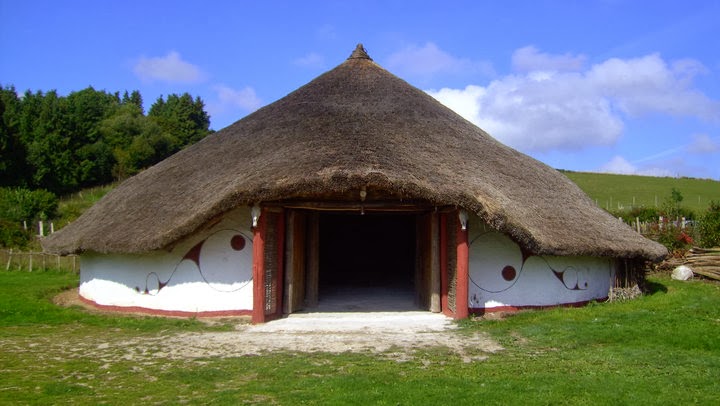
The Little Woodbury house at Butser Ancient Farm.
I decided that this was a question that needed investigation to better understand the people living in the past, and the impact of their environment on their health. It is a very big question and has many different elements to it so I decided that I would choose one area to focus on and then build up the research to a much bigger project looking at all the different elements. The first element I decided to focus my research on was that of the air quality within a thatched house with an open fire.

Over my time working in thatched houses with an open fire I observed peoples reaction to the smoke. The minority seem not to notice the smoke above their heads but more often than not a visitor will cough and make a comment about the smoke inside the house. Visitors are only ever in a house for a short period of time, I have stayed in such a house for a maximum of a week at a time but what would it be like to live in an environment like this for a lifetime?

The smoking fire inside the Little Woodbury at Butser Ancient Farm.
In Feburary 2013 I was fortunate to be invited to take part in an Iron Age living experiment at the Eindhoven Museum. This would involve a group of around 20 people living in reconstructed European Iron Age houses for a week as Iron Age people. This was the perfect opportunity to test the air quality within a thatched house with an open fire in a ‘real life situation’ (the houses being used would give a better impression of the environment within the house when in use than running the experiment in a dormant structure).

Some of the participants in the 'living experiment'.
In order to measure the air quality within a house I used a very basic method (there are much more scientific methods to measure air quality however my budget was limited. I hope that this experiment will lead to future work where these sorts of instruments can be used). Sample cards would be hung within a house being lived in for 12 hours at a time before being changed for a period of 6 days.

A sample card is a small square of card with a sticky blob in the centre that will catch particles in the air (including microscopic ones). These can then be counted and the results used to better understand the air quality in the environment being tested. There were two houses being lived in during the experiment so both environments were tested. Five sample cards were hung in each house in random locations. Five more were hung up in the outside environment away from the living experiment. These ‘outside’ cards would be used to compare the air quality within the houses to the air quality within a modern day city (Eindhoven).

An example of one of the test cards underneath the microscope showing the particulates trapped.
Once the living experiment was over the sample cards were carefully brought back to England for analysis. Each card was placed under a microscope and the particles stuck to the centre were counted and recorded onto a table. These results were then plotted onto a graph showing all the data for each individual card for each day. An average was then taken and the results plotted onto a graph.

Graph showing the average particulate counted for each individual card over the six days. A: house1, B:house2, C:outside environment.
Graph showing the average particulate count for each separate area. A: house1, B:house2, C:outside environment.
The graph of results shows us that there is very little difference between the average particulates between the two different houses (A and B) while there are slightly more particulates on the test cards placed in the outside environment (C). This indicates that the environment in a modern city is worse than that inside a thatched house with an open fire. The more particulates there are in the air the more detrimental the environment is to your health. These results would indicate that the effect on a person living in the houses health would be less than the impact of living in a modern day city.

Before drawing a firm conclusion from these results we must examine the limits to the experiment. The equipment used was very simple and all results have relied on human counting. This means that only particulates that could be seen under a basic microscope were counted. This means that some smaller particulates will not have been accounted for. The same counting method was used for all samples though so the comparison between them is fair.

I hope that this small experiment will act as a preliminary experiment that a more thorough research programme can develop from.

This experiment has demonstrated that the environment inside of a thatched building with an open fire is not as bad as the outdoor environment in a modern city, something for anyone in a round house next time they are at Butser Ancient Farm.

If you would like to find out more about this experiment and my results or have a question then please contact me and I will happily discuss this further.

I would like to thank: Butser Ancient Farm, Friends of Butser Ancient Farm, The Eindhoven Museum, the WEA, and all mu Dutch friends who participated in the living experiment.